
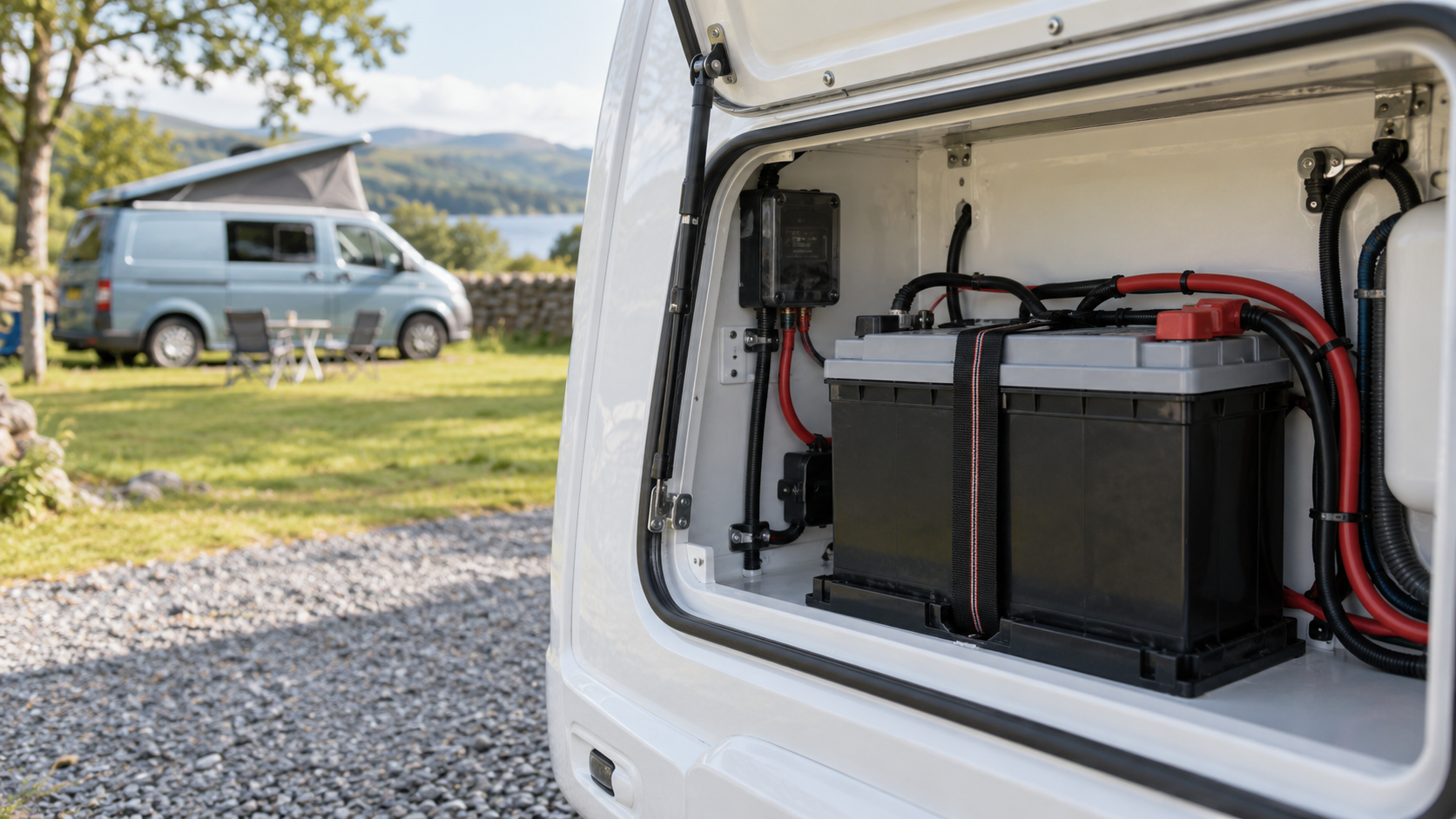
Hot weather increases a leisure battery’s self-discharge rate and can accelerate general wear – which is the single most common reason a caravan motor mover seems to “stop working” in summer. A quick pre-trip check of charge level, terminals and connections resolves most issues; if the mover still won’t engage properly with a fully charged battery, it’s time to get it looked at by a professional.
Why does hot weather affect your leisure battery?
Your caravan’s leisure battery is what powers the Powrtouch mover – the mover itself doesn’t have a separate battery of its own. (New to motor movers altogether? Our guide Do You Need a Caravan Motor Mover? explains how the whole system works.) Like any lead-acid or AGM battery, a leisure battery naturally loses charge over time even when it’s not being used, and that self-discharge happens faster in hot weather.
A battery that coped fine through spring, when it was topped up regularly and temperatures were mild, can find itself short of charge by the time you’re on your July getaway – especially after a long tow with the fridge, lights and other 12V systems all drawing on it too. Because a motor mover’s motors draw a meaningful current (more so with twin-axle and AWD models, which run two or four motors), a battery that’s “just about” coping with everything else may not have enough left for the mover to perform properly.
Heat also accelerates the longer-term wear that all batteries experience. A battery that’s a few years old and already on its way out tends to show its age fastest during a hot summer.
Signs your caravan mover battery needs attention
A few patterns are worth watching for:
- The rollers engage normally, but the motors sound weak, slow, or strain more than usual.
- The handset connects and responds, but the caravan doesn’t move — or moves much more slowly than you’d expect.
- The mover worked fine when you tested it at home, but struggles once you arrive after a long drive (a sign the battery’s been drawn down en route).
- Performance is inconsistent – fine one moment, sluggish or unresponsive the next.
Any of these point towards the battery rather than the mover itself, and are worth ruling out before assuming there’s a fault with the unit.
A quick pre-trip battery check (5-step list)
Before setting off – or as part of getting your caravan ready for the season – run through these five checks:
- Charge the leisure battery fully before you leave, ideally via a mains hookup or a proper leisure battery charger rather than relying solely on the car’s alternator during the drive there.
- Check the terminals for any corrosion or looseness, and clean them if needed – a poor connection has the same effect as a flat battery.
- Check any battery isolator switch is set to the correct position; if it’s been left off, the mover won’t get any power at all.
- Test the mover on your drive or hardstanding at home before you set off. If it engages and drives smoothly under load at home, you can be confident it’ll do the same once you arrive.
- If you’re heading off-grid for an extended period, think about how you’ll keep the battery topped up – solar, a generator, or simply driving regularly enough to let the alternator help – since a flat battery on day five is a much less convenient discovery than one on day one.
What if it’s not the battery? When to call in the experts
If you’ve worked through the checks above – battery charged, terminals clean, isolator switch correct – and the mover still won’t engage, run, or respond properly, the issue is most likely with the mover itself rather than its power supply.
This is where it’s worth remembering what’s backing your Powrtouch mover: every current model comes with a 5-year no-quibble guarantee covering both parts and labour, and Powrtouch’s mobile engineer network covers the UK and Ireland – so support isn’t limited to wherever you happen to have bought the mover. Whether you’re at home or partway through a touring trip, help is available without needing to find a local specialist yourself.
FAQs
Can I run my caravan mover off the car’s battery while towing? No – Powrtouch movers run from the caravan’s 12V leisure battery, not the towing vehicle’s battery, and shouldn’t be powered by any other source. Make sure the leisure battery is disconnected from any other supply, including the mains, when the mover is in use.
How long should a leisure battery last with a caravan mover? A good-quality leisure battery typically lasts around 3–5 years with regular use and proper charging, though heavy mover use, deep discharges and hot weather can shorten this. If your battery is several years old and struggling more than usual in summer heat, it may simply be due for replacement.
Does the Powrtouch mover have its own battery? No – the mover draws power directly from your caravan’s leisure battery rather than containing a battery of its own. That’s why keeping the leisure battery charged and in good condition matters so much for reliable performance.
What should I do if my mover stops working mid-trip? Start with the basics: check the leisure battery’s charge level and that the terminals and isolator switch are all in order, as this resolves most mid-trip issues. If the problem persists, Powrtouch’s mobile engineer network covers the UK and Ireland, so support is available wherever you are.
How often should I check my caravan mover’s battery? A quick check before every trip takes moments and catches most issues early. If your caravan has been stored over winter, it’s also worth checking and ideally maintaining on a smart charger, before the start of the touring season.
- Tags: caravan mover