
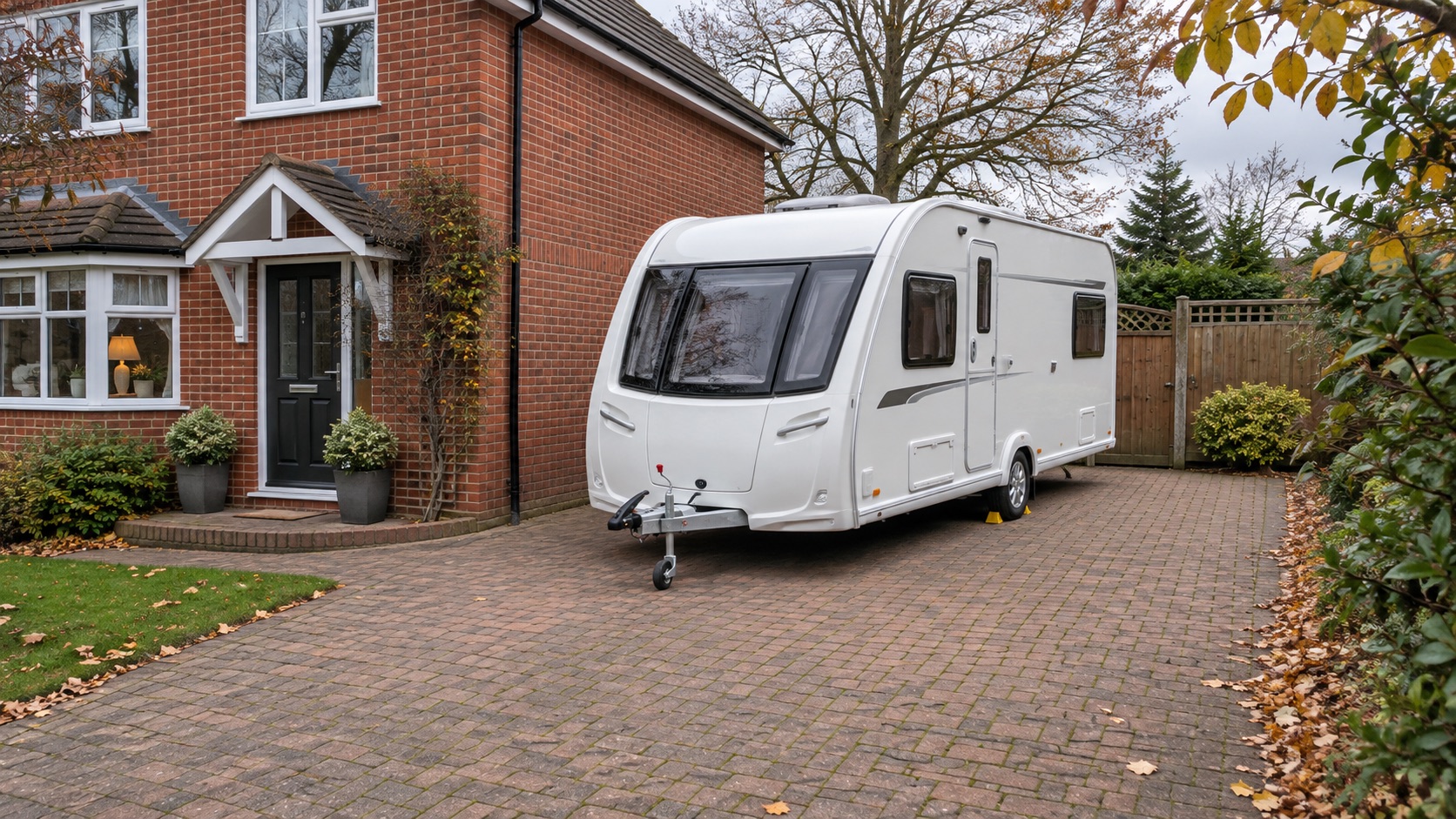
To get a caravan onto a driveway, measure the drive and gateway first, unhitch with the caravan as close to its final position as you can safely get it, then use a motor mover to guide it slowly into place. Once it is parked, level it, chock the wheels, disengage the mover and fit your security devices.
Plenty of owners bring the caravan home for the winter months, either to save on storage or to keep a closer eye on it. Driveways are rarely designed with a caravan in mind, so a little preparation makes a big difference.
Can you keep a caravan on a driveway?
In most cases, yes. Before you commit, check the following:
- Your property deeds, lease or estate rules, as some include restrictions on parking caravans
- With your landlord or management company if you rent or live on a managed development
- That the caravan will not overhang the pavement or block sightlines for drivers and pedestrians
- Your insurance policy, as some insurers set conditions for caravans stored at home
If anything is unclear, your local council or the company that manages your development can confirm the position.
How much space does a caravan need on a driveway?
Measure the caravan’s overall length, including the A-frame and jockey wheel, and its full width. Then measure the drive, the gateway and any pinch points such as gateposts, walls or the corner of the house.
Leave enough room to walk all the way round. You will need access to the door, the battery locker and the wheels for checks over the winter, and space to fit or remove a cover.
Look up as well as along. Overhanging branches drop sap and debris on the roof, and low gutters or porch roofs can catch the roof line as you manoeuvre.
How do you get a caravan onto a tight driveway?
A motor mover turns this into a one person job, although a second person acting as a spotter is always useful near gateposts and walls. Work through it in this order:
- Clear the drive of cars, bins and anything else in the way.
- Tow the caravan as close to the drive entrance as you safely can, ideally with it on your own property, and apply the caravan handbrake before unhitching.
- Lower the jockey wheel, raise the corner steadies and remove any wheel chocks.
- Switch the mover on at its isolation switch and engage the rollers.
- Release the handbrake, then move the caravan in short, slow movements, stopping often to check clearance.
- Once it is in position, apply the handbrake, disengage the rollers and switch the mover off at the isolation switch.
Take your time over the final few feet. A mover lets you make small adjustments that would be impossible with the car attached, so there is no need to get it right first time.
Find your nearest approved Powrtouch dealer to make driveway parking a one person job.
Can a motor mover handle a sloping driveway?
A motor mover can handle a sloping driveway as long as the slope and the caravan’s weight are within the mover’s rating. Powrtouch publishes the weight and gradient each model is rated for, and our guide to caravan motor mover weight and payload explains how to check your caravan against it.
A few habits help on a slope:
- Make sure the leisure battery is fully charged before you start
- Take the slope as straight on as you can rather than at an angle
- Watch for wet leaves, moss and frost, which reduce grip between the tyres and the ground
- Keep the handbrake within easy reach and apply it as soon as the caravan is in position
Our article on manoeuvring a caravan on wet and soft ground has more on autumn and winter surfaces.
How should you position a caravan on a driveway for winter?
Park the caravan level, using the jockey wheel and levelling ramps if needed, then lower the corner steadies so they take some of the load. Chock the wheels securely. Some owners prefer to leave the handbrake off during long storage to stop the brakes binding, relying on chocks and a wheel clamp instead, so follow your caravan manufacturer’s guidance on this.
Disengage the motor mover rollers so they are not pressing against the tyres for weeks at a time, and switch the mover off at its isolation switch. Our guide to preparing a caravan with a motor mover for winter storage covers the full checklist.
Every few weeks, move the caravan a short distance with the mover so the tyres rest on a different part of the tread. This helps avoid flat spots, and with a remote control it takes a minute.
How do you keep a caravan secure on a driveway?
A caravan on a driveway is visible from the road, so layered security is worth the effort. A hitch lock and a wheel clamp are the basics, and many owners add an alarm, a tracker or a security post. Keep the motor mover remote control inside the house rather than in the caravan.
Our guide to using a caravan wheel clamp with a motor mover explains how to make the two work together.
Have a question about your mover? Call the Powrtouch team on 01283 587900.
Caravan on a driveway: frequently asked questions
Do you need permission to keep a caravan on a driveway?
Usually not, but some property deeds, leases and estate rules restrict parking caravans at home. Check your paperwork, and ask your local council or management company if you are unsure.
Can one person put a caravan on a driveway?
Yes. With a motor mover, one person can position the caravan by remote control once it is unhitched. A second person acting as a spotter is still helpful near gateposts and walls.
Can a motor mover move a caravan up a sloping drive?
Yes, as long as the gradient and the caravan’s weight are within the mover’s rating and the leisure battery is fully charged. Take the slope straight on and move slowly.
Should the motor mover be left engaged on the driveway?
No. Once the caravan is parked, disengage the rollers so they are not pressing on the tyres, and switch the mover off at its isolation switch.
How often should a caravan on a driveway be moved?
Moving it a short distance every few weeks lets the tyres rest on a different part of the tread, which helps avoid flat spots. A motor mover makes this a quick job.